Multi-Split vs Separate Air Conditioners: Cost Comparison
A multi-split reduces the number of outdoor units but is not automatically cheaper. Pipe routes, simultaneous loads, installation complexity, maintenance and the consequence of one outdoor-unit fault all affect value.

A multi-split reduces the number of outdoor units but is not automatically cheaper. Pipe routes, simultaneous loads, installation complexity, maintenance and the consequence of one outdoor-unit fault all affect value.
Key points
- A multi-split reduces the number of outdoor units but is not automatically cheaper. Pipe routes, simultaneous loads, installation complexity, maintenance and the consequence of one outdoor-unit fault all affect value.
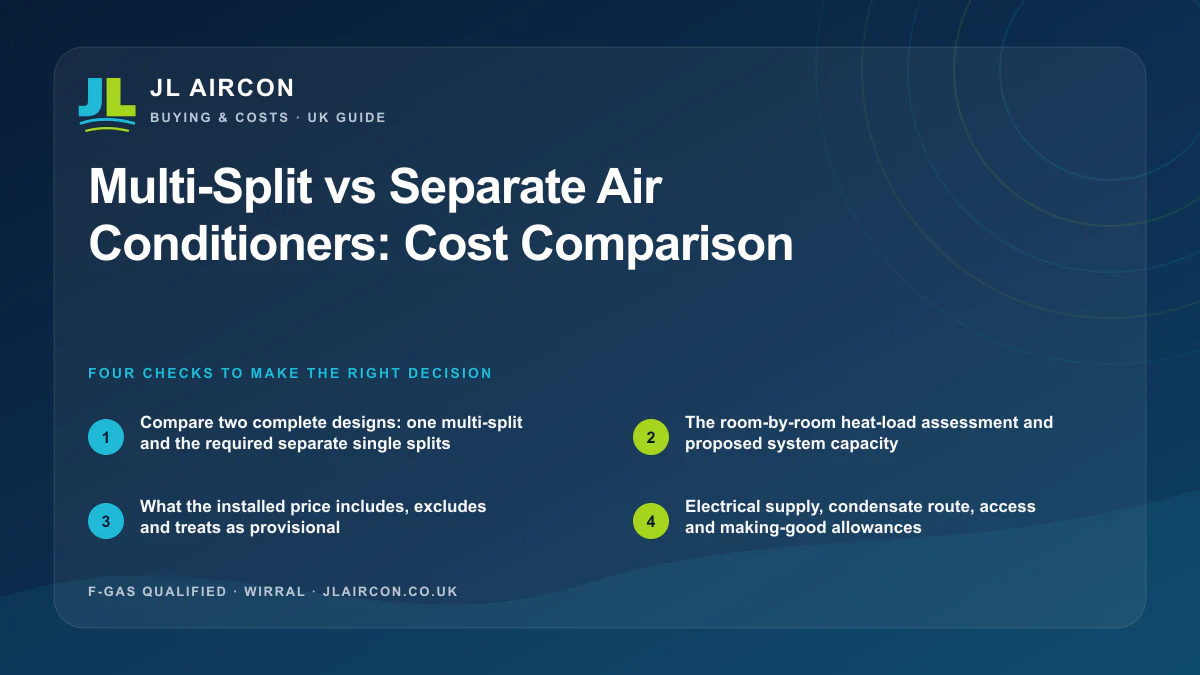
- Compare two complete designs: one multi-split and the required separate single splits. Count outdoor positions, usable capacity combinations and future repair impact, not only equipment quantity.
- Start with a written load summary and the exact indoor-outdoor model pairing and show how it changes the answer for multi split vs single split cost.
- Confirm the final model, route, included work and any applicable UK permission or competence boundary against the actual property.
Direct answer
A multi-split reduces the number of outdoor units but is not automatically cheaper. Pipe routes, simultaneous loads, installation complexity, maintenance and the consequence of one outdoor-unit fault all affect value.
For readers researching multi split vs single split cost, the practical starting point is this: Compare two complete designs: one multi-split and the required separate single splits. Count outdoor positions, usable capacity combinations and future repair impact, not only equipment quantity.
the question “Multi-Split vs Separate Air Conditioners: Cost Comparison” cannot be settled from one headline number. For this comparison question about “multi vs single cost”, put both options against the same room, route, operating pattern and aftercare requirement before deciding which difference is meaningful. For “Multi-Split vs Separate Air Conditioners: Cost Comparison”, this guide stays focused on the reader's real goal, which is to compare quotations on a like-for-like basis before committing; it does not assign a model remotely or turn a general rule into property evidence.
Keep three labels beside research for this comparison question about “multi vs single cost”: facts supported by measurements, documents or current rules; assumptions still awaiting confirmation; and decisions such as capacity, position, scope or next action. That separation makes this comparison question about “multi vs single cost” auditable because another person can see exactly where judgement begins.
A realistic example for multi split vs single split cost
Suppose two proposals both claim to answer the question “Multi-Split vs Separate Air Conditioners: Cost Comparison”. One option for this comparison question about “multi vs single cost” is designed around a compact loft room with a short gravity drain and an accessible ground-mounted outdoor unit; the other assumes a short gravity drain and an accessible ground-mounted outdoor unit. A product-only answer to comparison question about “multi vs single cost” would miss route, access, noise and maintenance differences. Re-state both options for comparison question about “multi vs single cost” against the same room duty and written installation scope before comparing what remains. For this comparison question about “multi vs single cost”, price, efficiency or convenience becomes meaningful only after that like-for-like correction.
This example is specific to the comparison question about “multi vs single cost” because a useful proposal must show which changed input would alter the result, rather than hiding room, route, use or model trade-offs behind a broad recommendation.
Evidence to collect before deciding
| Check | Why it matters for this question | Useful evidence |
|---|---|---|
| The room-by-room heat-load assessment and proposed system capacity | It establishes whether the proposed capacity and model are being priced for the same room duty; for this comparison question about “multi vs single cost”, it supports the answer rather than acting as a generic survey note. | A written load summary and the exact indoor-outdoor model pairing |
| What the installed price includes, excludes and treats as provisional | It separates a complete installed figure from allowances that may become extras later; for this comparison question about “multi vs single cost”, it supports the answer rather than acting as a generic survey note. | An itemised scope with VAT, exclusions and provisional sums identified |
| Electrical supply, condensate route, access and making-good allowances | It exposes work that can materially alter labour, access or third-party costs; for this comparison question about “multi vs single cost”, it supports the answer rather than acting as a generic survey note. | A route sketch covering power, pipework, drain, access and making good |
| Model numbers, warranty conditions and aftercare responsibilities | It shows what support remains after the installation invoice has been paid; for this comparison question about “multi vs single cost”, it supports the answer rather than acting as a generic survey note. | Warranty terms, registration steps, service conditions and claim contact |
For multi split vs single split cost, collect each item to confirm or reject an assumption in the proposal; anything unavailable before the visit should become a named survey check with a stated consequence for route, capacity, accessory, permission or price.
Evidence for this comparison question about “multi vs single cost” should establish scale and context: photograph the complete wall or elevation before the close view, state measurement start and end points, and identify the exact matched indoor-outdoor model because one range can contain materially different capacities.
A property-specific decision process
- Compare the proposed pipe, drain and electrical routes, not only the headline total: A route comparison explains genuine price differences between proposals; record the result for this comparison question about “multi vs single cost”.
- Check which findings can still change the price after the site survey: Written survey items prevent a headline price being mistaken for a fixed total; record the result for this comparison question about “multi vs single cost”.
- Keep the final specification, commissioning record and warranty documents together: The document set supports warranty claims, maintenance and later property records; record the result for this comparison question about “multi vs single cost”.
- Write down what the room must achieve: summer cooling, winter heating or both: This fixes the buying objective before product features influence the choice; record the result for this comparison question about “multi vs single cost”.
- Ask for an itemised quotation tied to exact indoor and outdoor model numbers: Exact model numbers make efficiency, sound and warranty comparisons possible; record the result for this comparison question about “multi vs single cost”.
For this comparison question about “multi vs single cost”, the sequence should leave one short record in which the room objective, selected equipment, route, permissions, included work and unresolved items agree; where they conflict, return to the first unsupported assumption instead of covering uncertainty with extra capacity or features.
Use the record according to this comparison question about “multi vs single cost”: comparisons need identical headings and scope, while fault or maintenance research needs a safe symptom log that keeps invasive, electrical and refrigerant work outside owner checks.
Common wrong turns and how to correct them
- Choosing the lowest headline figure without matching the scope: Rebuild the comparison using an identical written scope, then apply that correction before relying on this comparison question about “multi vs single cost”.
- Assuming every room needs the same capacity: Return to the room duty and low-load performance, not catalogue size alone, then apply that correction before relying on this comparison question about “multi vs single cost”.
- Treating an online estimate as a substitute for a technical check: Label the online result as an estimate until the property checks are complete, then apply that correction before relying on this comparison question about “multi vs single cost”.
- Leaving access, drainage or electrical work undefined: Assign responsibility and an allowance for each unresolved route item, then apply that correction before relying on this comparison question about “multi vs single cost”.
Treat an answer to multi split vs single split cost as weak if it stays unchanged when meaningful room use, heat gain, model data, route, sound, drainage, electrical or consent evidence changes; certainty without those inputs is not a property-specific conclusion.
UK rules and source evidence
JL Aircon reviewed “Multi-Split vs Separate Air Conditioners: Cost Comparison” on 8 August 2026 against the sources below; for multi split vs single split cost, they set regulatory or technical boundaries but do not approve a proposal, replace model instructions or freeze rules after the review date.
- [VAT Notice 708/6: energy-saving materials and heating equipment](https://www.gov.uk/guidance/vat-on-energy-saving-materials-and-heating-equipment-notice-7086), HM Revenue & Customs: Official VAT guidance for qualifying fixed air-source heat pumps and installations; apply that boundary to the actual proposal behind this comparison question about “multi vs single cost”.
- [Qualifications required to work on equipment containing F gas](https://www.gov.uk/guidance/qualifications-required-to-work-on-equipment-containing-f-gas), GOV.UK: Official qualification requirements for stationary refrigeration, air-conditioning and heat-pump work; apply that boundary to the actual proposal behind this comparison question about “multi vs single cost”.
- [Building regulations approval: when you need approval](https://www.gov.uk/building-regulations-approval/when-you-need-approval), GOV.UK: Official overview of work covered by Building Regulations, including fixed air-conditioning systems; apply that boundary to the actual proposal behind this comparison question about “multi vs single cost”.
When this comparison question about “multi vs single cost” touches refrigerant competence, electrics, planning, Building Regulations, private consent or health, test each applicable boundary separately; one approval does not settle the others, and current NHS or UKHSA advice takes priority where heat is affecting health.
Questions to put to the installer
- For this comparison question about “multi vs single cost”, which parts of this figure are fixed and which remain provisional?
- For this comparison question about “multi vs single cost”, which exact model combination and installation route does the total cover?
- For this comparison question about “multi vs single cost”, who completes and certifies the electrical work?
- For this comparison question about “multi vs single cost”, what registration, servicing or exclusions affect the warranty?
Answers to this comparison question about “multi vs single cost” should name the evidence, exact model or property condition behind the recommendation and put material assumptions or exclusions in writing, creating a record useful to the owner, installation team and future service engineer.
JL Aircon can use measurements and photographs to narrow this comparison question about “multi vs single cost”, while reserving the final design for the surveyed property so an early online discussion improves the visit without pretending the route and technical details are already known.
Bottom line
A multi-split reduces the number of outdoor units but is not automatically cheaper. Pipe routes, simultaneous loads, installation complexity, maintenance and the consequence of one outdoor-unit fault all affect value. For multi split vs single split cost, the next useful action is to compare quotations on a like-for-like basis before committing, using a written load summary and the exact indoor-outdoor model pairing as the first recorded check. Compare two complete designs: one multi-split and the required separate single splits. Count outdoor positions, usable capacity combinations and future repair impact, not only equipment quantity.
Treat multi split vs single split cost as a decision with inputs and boundaries, not just a phrase to search. A strong answer to “Multi-Split vs Separate Air Conditioners: Cost Comparison” states its assumptions, cites any rule or rating, explains what would change the recommendation and leaves a clear path to on-site confirmation where needed.
Related JL Aircon guidance
Quick answers
Multi-Split vs Separate Air Conditioners: Cost Comparison?
A multi-split reduces the number of outdoor units but is not automatically cheaper. Pipe routes, simultaneous loads, installation complexity, maintenance and the consequence of one outdoor-unit fault all affect value.
Which evidence matters most for “Multi-Split vs Separate Air Conditioners: Cost Comparison”?
A written load summary and the exact indoor-outdoor model pairing and an itemised scope with vat, exclusions and provisional sums identified are the strongest starting points for multi split vs single split cost; compare two complete designs: one multi-split and the required separate single splits. Count outdoor positions, usable capacity combinations and future repair impact, not only equipment quantity.
Can multi split vs single split cost be assessed online?
A desk comparison is useful only after both options use the same room duty, route and included scope; use that boundary when assessing multi split vs single split cost, then record what an on-site check still needs to confirm.
What should I ask an installer about multi split vs single split cost?
For multi split vs single split cost, ask “Which parts of this figure are fixed and which remain provisional?” and “Which exact model combination and installation route does the total cover?”; the reply should refer to the actual property and exact model rather than a general rule.
Sources and review record
JL Aircon reviewed this article on . Rules, tariffs and manufacturer guidance can change, so the current linked source takes priority.
- VAT Notice 708/6: energy-saving materials and heating equipmentHM Revenue & Customs ↗
Official VAT guidance for qualifying fixed air-source heat pumps and installations.
- Qualifications required to work on equipment containing F gasGOV.UK ↗
Official qualification requirements for stationary refrigeration, air-conditioning and heat-pump work.
- Building regulations approval: when you need approvalGOV.UK ↗
Official overview of work covered by Building Regulations, including fixed air-conditioning systems.
Turn the research into a clear installation plan.
Tell JL Aircon about the room, property and preferred route. We will check the assumptions before anything is fixed to the wall.