What Room Size Will a 2.5 kW Air Conditioner Cool?
A 2.5 kW label describes nominal cooling output, not a guaranteed square-metre coverage. Two rooms of equal area can have very different heat gains.

A 2.5 kW label describes nominal cooling output, not a guaranteed square-metre coverage. Two rooms of equal area can have very different heat gains.
Key points
- A 2.5 kW label describes nominal cooling output, not a guaranteed square-metre coverage. Two rooms of equal area can have very different heat gains.
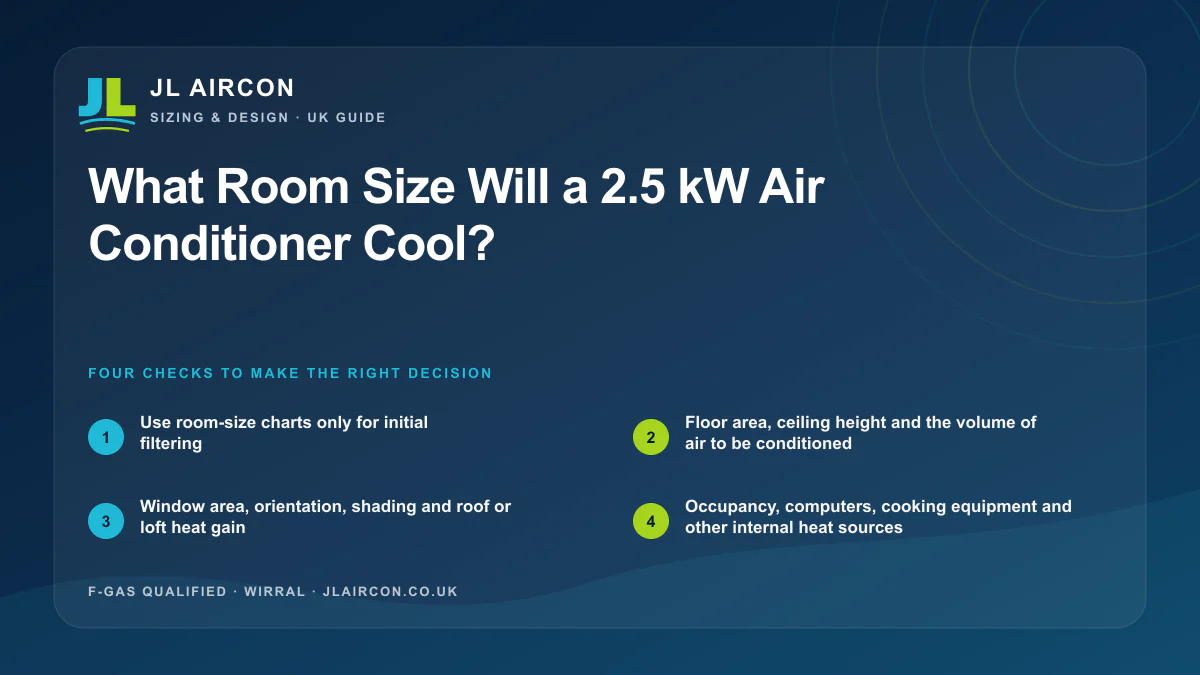
- Use room-size charts only for initial filtering. A small shaded bedroom and a glass-heavy loft office should not receive the same recommendation merely because their floors match.
- Start with measured length, width, average height and any open connection to another space and show how it changes the answer for 2.5 kW air conditioner room size.
- Confirm the final model, route, included work and any applicable UK permission or competence boundary against the actual property.
Direct answer
A 2.5 kW label describes nominal cooling output, not a guaranteed square-metre coverage. Two rooms of equal area can have very different heat gains.
For readers researching 2.5 kW air conditioner room size, the practical starting point is this: Use room-size charts only for initial filtering. A small shaded bedroom and a glass-heavy loft office should not receive the same recommendation merely because their floors match.
the question “What Room Size Will a 2.5 kW Air Conditioner Cool” is a heat-load and air-distribution problem. For this sizing question about “2.5 kw room size”, floor area is only the start; glazing, orientation, roof exposure, people, equipment and the model's operating range complete the decision. For “What Room Size Will a 2.5 kW Air Conditioner Cool”, this guide stays focused on the reader's real goal, which is to understand the design choices that determine comfort and efficiency; it does not assign a model remotely or turn a general rule into property evidence.
Keep three labels beside research for this sizing question about “2.5 kw room size”: facts supported by measurements, documents or current rules; assumptions still awaiting confirmation; and decisions such as capacity, position, scope or next action. That separation makes this sizing question about “2.5 kw room size” auditable because another person can see exactly where judgement begins.
A realistic example for 2.5 kW air conditioner room size
For this sizing question about “2.5 kw room size”, compare a compact loft room with a second room of the same floor area but different glazing, shade and equipment. The two cases for sizing question about “2.5 kw room size” can need different peak duties and indoor positions. For the question “What Room Size Will a 2.5 kW Air Conditioner Cool”, record geometry first, then add solar and internal gains and check the selected model's minimum as well as maximum output. This sizing question about “2.5 kw room size” example shows why a square-metre chart is a filter rather than a final design.
This example is specific to the sizing question about “2.5 kw room size” because a useful proposal must show which changed input would alter the result, rather than hiding room, route, use or model trade-offs behind a broad recommendation.
Evidence to collect before deciding
| Check | Why it matters for this question | Useful evidence |
|---|---|---|
| Floor area, ceiling height and the volume of air to be conditioned | Room volume sets the starting scale but does not capture the heat entering the space; for this sizing question about “2.5 kw room size”, it supports the answer rather than acting as a generic survey note. | Measured length, width, average height and any open connection to another space |
| Window area, orientation, shading and roof or loft heat gain | Solar gain can make equal-sized rooms need different peak cooling duties; for this sizing question about “2.5 kw room size”, it supports the answer rather than acting as a generic survey note. | Window dimensions, orientation, roof exposure and the timing of direct sun |
| Occupancy, computers, cooking equipment and other internal heat sources | People and equipment release heat inside the room throughout occupied periods; for this sizing question about “2.5 kw room size”, it supports the answer rather than acting as a generic survey note. | Normal occupancy plus the rated or measured load of meaningful equipment |
| Air path, indoor-unit throw, outdoor-unit position and drainage fall | A correct duty still performs poorly if air cannot reach the occupied zone or services cannot be routed safely; for this sizing question about “2.5 kw room size”, it supports the answer rather than acting as a generic survey note. | A marked indoor position, airflow path, outdoor position and gravity-drain option |
For 2.5 kW air conditioner room size, collect each item to confirm or reject an assumption in the proposal; anything unavailable before the visit should become a named survey check with a stated consequence for route, capacity, accessory, permission or price.
Evidence for this sizing question about “2.5 kw room size” should establish scale and context: photograph the complete wall or elevation before the close view, state measurement start and end points, and identify the exact matched indoor-outdoor model because one range can contain materially different capacities.
A property-specific decision process
- Mark viable indoor and outdoor positions before selecting a capacity: Position checks connect the load calculation to comfort and buildability; record the result for this sizing question about “2.5 kw room size”.
- Have the final duty checked against the actual property and chosen model: The matched model can then be checked at both minimum and maximum output; record the result for this sizing question about “2.5 kw room size”.
- Measure length, width and ceiling height rather than estimating by eye: Measured geometry prevents a floor-area guess becoming the final selection; record the result for this sizing question about “2.5 kw room size”.
- Record glazing size, compass orientation and when direct sun reaches the room: The solar record identifies when the design peak is likely to occur; record the result for this sizing question about “2.5 kw room size”.
- List normal occupancy and meaningful heat-producing equipment: Normal internal gains keep the estimate realistic rather than worst-case by default; record the result for this sizing question about “2.5 kw room size”.
For this sizing question about “2.5 kw room size”, the sequence should leave one short record in which the room objective, selected equipment, route, permissions, included work and unresolved items agree; where they conflict, return to the first unsupported assumption instead of covering uncertainty with extra capacity or features.
Use the record according to this sizing question about “2.5 kw room size”: comparisons need identical headings and scope, while fault or maintenance research needs a safe symptom log that keeps invasive, electrical and refrigerant work outside owner checks.
Common wrong turns and how to correct them
- Sizing from floor area alone: Replace the area-only rule with a recorded room and heat-gain assessment, then apply that correction before relying on this sizing question about “2.5 kw room size”.
- Oversizing for faster cooling and creating short cycling: Check the inverter's minimum output before adding a broad safety margin, then apply that correction before relying on this sizing question about “2.5 kw room size”.
- Ignoring a hot roof space or large west-facing glazing: Add roof and glazing exposure explicitly to the design inputs, then apply that correction before relying on this sizing question about “2.5 kw room size”.
- Putting the unit where furniture or a doorway blocks useful airflow: Move the unit or furniture so the occupied area sits inside a useful air path, then apply that correction before relying on this sizing question about “2.5 kw room size”.
Treat an answer to 2.5 kW air conditioner room size as weak if it stays unchanged when meaningful room use, heat gain, model data, route, sound, drainage, electrical or consent evidence changes; certainty without those inputs is not a property-specific conclusion.
UK rules and source evidence
JL Aircon reviewed “What Room Size Will a 2.5 kW Air Conditioner Cool” on 8 August 2026 against the sources below; for 2.5 kW air conditioner room size, they set regulatory or technical boundaries but do not approve a proposal, replace model instructions or freeze rules after the review date.
- [Residential air-to-air heat-pump maintenance guidance](https://www.daikin.co.uk/en_gb/residential/services/maintenance.html), Daikin UK: Manufacturer advice on filter care; the instructions for the installed model take precedence; apply that boundary to the actual proposal behind this sizing question about “2.5 kw room size”.
- [Qualifications required to work on equipment containing F gas](https://www.gov.uk/guidance/qualifications-required-to-work-on-equipment-containing-f-gas), GOV.UK: Official qualification requirements for stationary refrigeration, air-conditioning and heat-pump work; apply that boundary to the actual proposal behind this sizing question about “2.5 kw room size”.
- [Building regulations approval: when you need approval](https://www.gov.uk/building-regulations-approval/when-you-need-approval), GOV.UK: Official overview of work covered by Building Regulations, including fixed air-conditioning systems; apply that boundary to the actual proposal behind this sizing question about “2.5 kw room size”.
When this sizing question about “2.5 kw room size” touches refrigerant competence, electrics, planning, Building Regulations, private consent or health, test each applicable boundary separately; one approval does not settle the others, and current NHS or UKHSA advice takes priority where heat is affecting health.
Questions to put to the installer
- For this sizing question about “2.5 kw room size”, which heat gains produced the proposed duty?
- For this sizing question about “2.5 kw room size”, what is the matched system's minimum as well as nominal output?
- For this sizing question about “2.5 kw room size”, how will air reach the occupied part of the room without a constant draught?
- For this sizing question about “2.5 kw room size”, which uncertain input would most change the selected capacity?
Answers to this sizing question about “2.5 kw room size” should name the evidence, exact model or property condition behind the recommendation and put material assumptions or exclusions in writing, creating a record useful to the owner, installation team and future service engineer.
JL Aircon can use measurements and photographs to narrow this sizing question about “2.5 kw room size”, while reserving the final design for the surveyed property so an early online discussion improves the visit without pretending the route and technical details are already known.
Bottom line
A 2.5 kW label describes nominal cooling output, not a guaranteed square-metre coverage. Two rooms of equal area can have very different heat gains. For 2.5 kW air conditioner room size, the next useful action is to understand the design choices that determine comfort and efficiency, using measured length, width, average height and any open connection to another space as the first recorded check. Use room-size charts only for initial filtering. A small shaded bedroom and a glass-heavy loft office should not receive the same recommendation merely because their floors match.
Treat 2.5 kW air conditioner room size as a decision with inputs and boundaries, not just a phrase to search. A strong answer to “What Room Size Will a 2.5 kW Air Conditioner Cool” states its assumptions, cites any rule or rating, explains what would change the recommendation and leaves a clear path to on-site confirmation where needed.
Related JL Aircon guidance
Quick answers
What Room Size Will a 2.5 kW Air Conditioner Cool?
A 2.5 kW label describes nominal cooling output, not a guaranteed square-metre coverage. Two rooms of equal area can have very different heat gains.
Which evidence matters most for “What Room Size Will a 2.5 kW Air Conditioner Cool”?
Measured length, width, average height and any open connection to another space and window dimensions, orientation, roof exposure and the timing of direct sun are the strongest starting points for 2.5 kW air conditioner room size; use room-size charts only for initial filtering. A small shaded bedroom and a glass-heavy loft office should not receive the same recommendation merely because their floors match.
Can 2.5 kW air conditioner room size be assessed online?
A calculator can produce a range; final capacity and model selection need the real construction, gains, positions and operating range; use that boundary when assessing 2.5 kW air conditioner room size, then record what an on-site check still needs to confirm.
What should I ask an installer about 2.5 kW air conditioner room size?
For 2.5 kW air conditioner room size, ask “Which heat gains produced the proposed duty?” and “What is the matched system's minimum as well as nominal output?”; the reply should refer to the actual property and exact model rather than a general rule.
Sources and review record
JL Aircon reviewed this article on . Rules, tariffs and manufacturer guidance can change, so the current linked source takes priority.
- Residential air-to-air heat-pump maintenance guidanceDaikin UK ↗
Manufacturer advice on filter care; the instructions for the installed model take precedence.
- Qualifications required to work on equipment containing F gasGOV.UK ↗
Official qualification requirements for stationary refrigeration, air-conditioning and heat-pump work.
- Building regulations approval: when you need approvalGOV.UK ↗
Official overview of work covered by Building Regulations, including fixed air-conditioning systems.
Turn the research into a clear installation plan.
Tell JL Aircon about the room, property and preferred route. We will check the assumptions before anything is fixed to the wall.